Retirement Tax Planning: Where Your Income Comes From Changes What You Keep
How Social Security, IRAs, Roth accounts and brokerage accounts are taxed in retirement, and why the order you draw income changes your tax bill and Medicare.


Most people walk into retirement asking one question: do I have enough? It's the right question, but it's only half of it. The other half is how much of your retirement income you'll actually keep after taxes.
While you're working, you don't get much say in that. A paycheck comes in, taxes come out, and you move on. Retirement is different. Your income now comes from several places at once, each one taxed its own way, and you decide how much to pull from each place and when. That choice is where most of the planning lives.
How each source of retirement income is taxed
Here's how the federal government treats money coming out of each bucket.

If you live in Washington, there's no state income tax on any of this, so the federal return is most of the story. (Washington does tax large capital gains, which matters if you're selling a big block of appreciated stock.)
Social Security is taxed differently than people expect
Social Security tends to trip people up more than anything else on that list. The rule is that up to 85% of your benefit can be added to your taxable income, and then taxed at your normal rate.
How much gets added depends on what the IRS calls provisional income: roughly your other income plus half your Social Security. For a married couple filing jointly, benefits start becoming taxable above $32,000 of provisional income, and up to 85% is taxable above $44,000. For single filers those lines are $25,000 and $34,000.
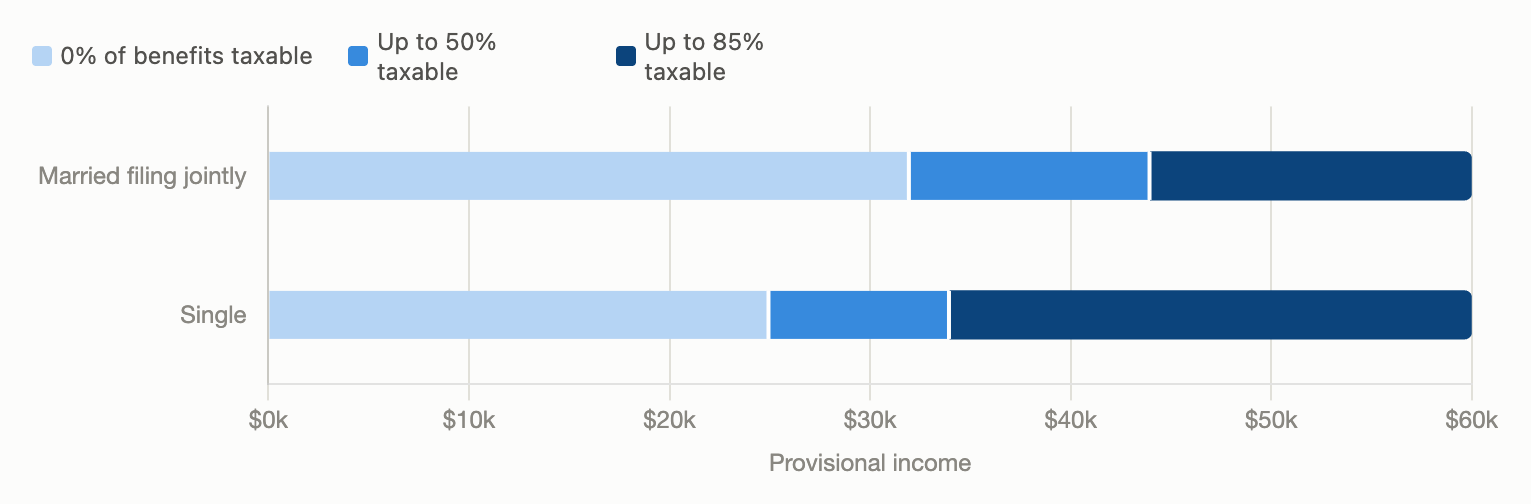
Those thresholds were set in 1983 and 1993 and have never been adjusted for inflation. That's why more retirees get caught by them every year.
There's one recent change in the other direction. For tax years 2025 through 2028, people 65 and older can take an extra deduction of up to $6,000 each ($12,000 for a married couple when both qualify). It starts phasing out above $75,000 of income for single filers and $150,000 for joint filers. For retirees living mostly on Social Security, that deduction can wipe out a good share of the tax.
The order you draw income matters
Because each bucket is taxed differently, the same $100,000 of spending can produce very different tax bills depending on where it comes from. Pull it all from a traditional IRA and every dollar is ordinary income. Pull some from a brokerage account and only the gain counts, possibly at 0%. Pull some from a Roth and that part doesn't show up on your return at all.
This is the part most people never plan. They take what's easiest, usually the biggest account, and find out in April what it costs.
A better approach looks a few years ahead. If your income will jump later (when Social Security starts, or when required minimum distributions begin), it can make sense to fill up a low bracket now on purpose rather than let a high one fill up for you later.
Roth conversions, RMDs and QCDs
Three tools come up again and again in retirement tax planning.
Roth conversions
You move money from a traditional IRA to a Roth IRA and pay ordinary income tax on the amount converted that year. Why pay tax early? Because if your bracket is lower now than it will be later, you're paying at the lower rate. The years between retiring and starting RMDs are often the best window. We cover this in detail in our Roth conversion video.
Required minimum distributions (RMDs)
At some point the IRS makes you start pulling money out of traditional IRAs and 401(k)s, whether you need it or not. RMDs start at 73 if you were born from 1951 through 1959, and at 75 if you were born in 1960 or later. Large RMDs can increase taxable income, potentially move you into a higher tax bracket, increase Medicare premiums, or affect the taxation of other retirement income.
Qualified charitable distributions (QCDs)
Once you're 70½, you can send money straight from your IRA to a charity. It counts toward your RMD once those begin, and it never shows up as taxable income. In 2026 you can give up to $111,000 per person this way. If you already give to charity, this is often the most tax efficient way to do it.
How retirement income affects Medicare premiums
This one catches a lot of people off guard. Medicare Part B premiums go up when your income passes certain levels, through a surcharge called IRMAA (income-related monthly adjustment amount).
In 2026 the standard Part B premium is $202.90 a month. A married couple whose modified adjusted gross income was above $218,000 (or a single filer above $109,000) pays $284.10 a month each instead. For a couple, that first step costs about $1,950 a year.
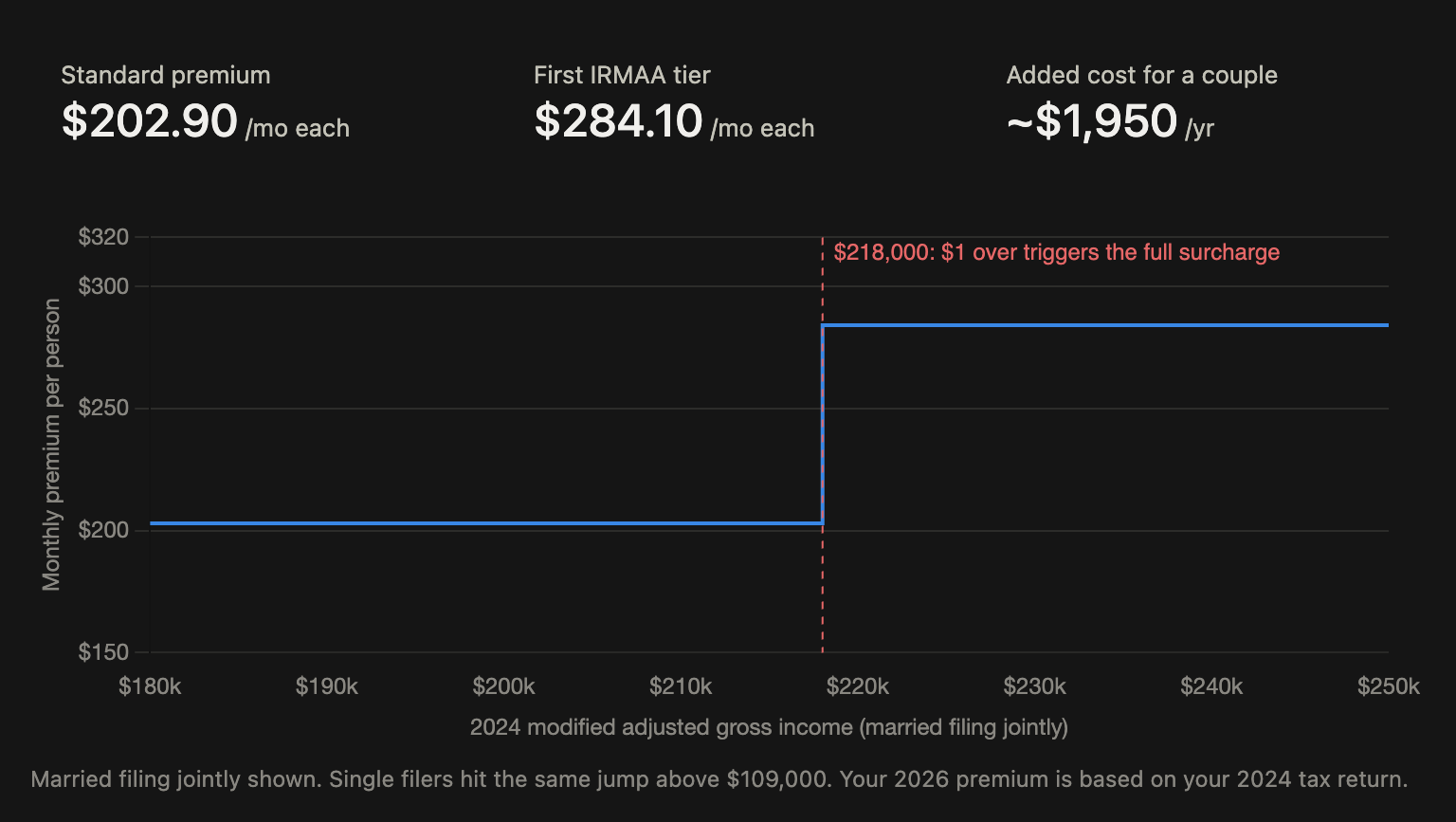
Two details make it tricky. Medicare looks back two years, so your 2026 premium is based on your 2024 tax return. And it's a cliff: one dollar over the line triggers the whole surcharge. A large IRA withdrawal or a Roth conversion that's sized without IRMAA in mind can cost more than the tax itself.
Claiming Social Security too early
When you claim Social Security is a tax decision as well as an income decision. For each year you wait past full retirement age, up to 70, your benefit grows by about 8%. For anyone born in 1960 or later, full retirement age is 67.
Claiming early can make sense, especially for health reasons, but it adds taxable income during what could be your lowest-tax years, which can be the best window for Roth conversions and capital gains planning. We see clients who are anxious to start benefits as soon as they can. It's worth running the numbers both ways first.
Common retirement tax mistakes
- Drawing from whichever account is biggest or easiest, without a plan for the order
- Waiting until RMDs start to think about the size of the traditional IRA
- Doing a Roth conversion or a large withdrawal without checking the IRMAA lines
- Giving to charity from a checking account when a QCD would have kept that money off the return
- Treating Social Security timing as separate from the tax plan
Where to start
Pull up last year's tax return and find your taxable income on Form 1040. Then look up which bracket it landed in. That one number tells you how much room you have before the next bracket, and it's the starting point for every decision above.
If you'd like to see how this plays out on your own numbers, book a free intro call. We'll show you the math and tell you honestly what we'd do. No pressure either way.
Frequently asked questions
Is Social Security taxed at 85%?
No. Up to 85% of your benefit can be counted as taxable income, depending on your other income. That portion is then taxed at your normal rate.
At what age do RMDs start?
At 73 if you were born from 1951 through 1959, and at 75 if you were born in 1960 or later.
Can a Roth conversion raise my Medicare premiums?
Yes. A conversion adds to your income for the year, and Medicare uses that income two years later to set your Part B and Part D premiums.
Do QCDs count toward my RMD?
Yes. Once RMDs begin, a qualified charitable distribution counts toward the amount you have to take, and it isn't included in your taxable income.
Trey Gevers CFP®
Trey Gevers is a CERTIFIED FINANCIAL PLANNER™ and managing partner at Gevers Wealth in Issaquah, WA, specializing in helping people navigate retirement with clarity and confidence. He's known for turning complex financial strategies into plans that are actually easy to understand — because he believes a great plan should build your future and let you enjoy the life you're living right now.
Continue Reading
Discover additional articles to help you stay informed and make thoughtful financial decisions over time.





































Book a Free Assessment Today
Set up a relaxed introductory call to see if we are a good fit.