NUA for Costco Employees: The Tax Strategy Hiding in Your 401(k)
Costco stock in your 401(k)? NUA can move it out at capital gains rates instead of income tax rates. How it works, the four rules, and the real trade-offs.


Paul and Linda are 60 and 61, recently retired from Costco, and they need about $120,000 a year to live on. In 2026 they can pull all of it from their Costco stock and owe $0 in federal tax on it.
That sounds too good to be true the first time you hear it. It isn't a loophole. It's the result of two ordinary pieces of the tax code lining up: a rule called net unrealized appreciation, and the 0% capital gains bracket.
The catch is timing. Most people retiring from Costco roll their whole 401(k) into an IRA, because that's the normal thing to do. Once the Costco stock lands in that IRA, the option for NUA is gone, and every dollar that comes out later is taxed as ordinary income, anywhere from 10% to 37%.
What net unrealized appreciation means
Net unrealized appreciation, or NUA, is the growth on company stock held inside your 401(k). If you bought Costco shares in the plan over 25 years and they're worth far more today than you paid, the difference is your NUA.
The tax code lets you treat that growth differently from everything else in the account. Instead of moving the whole 401(k) into one bucket, you split it in two.
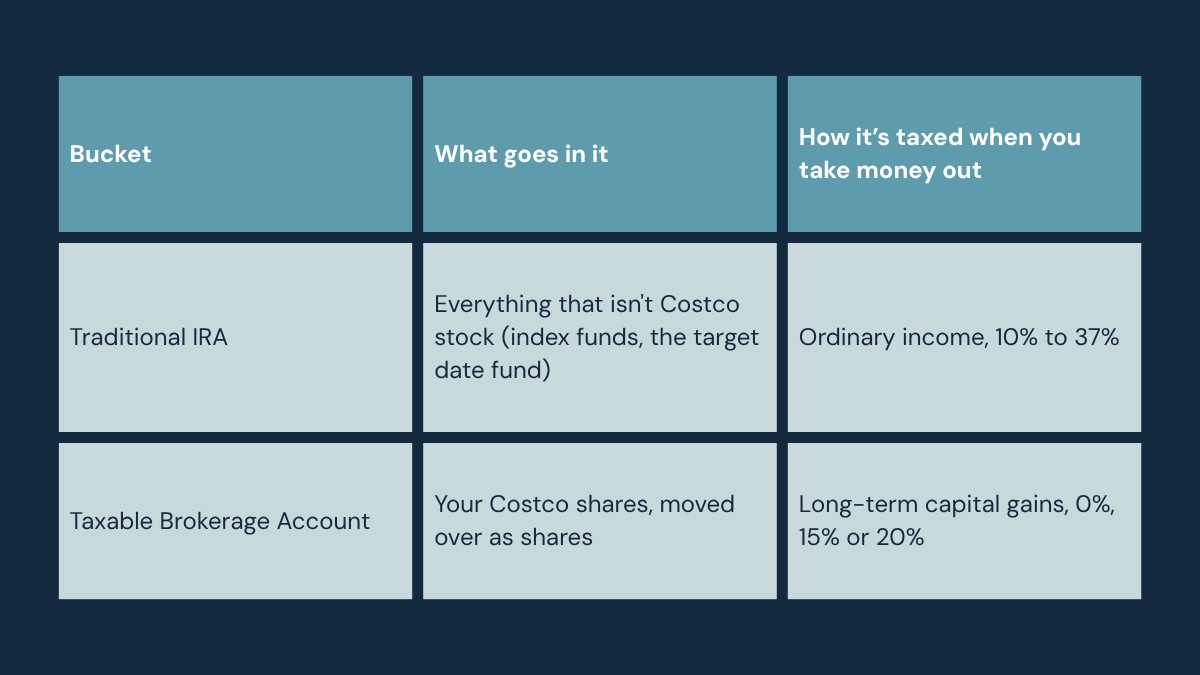
The brokerage bucket is the whole point. Given the choice, I'll take capital gains rates over paycheck rates ten times out of ten.
Why this comes up so often at Costco
Very few companies let employees buy their own stock inside the 401(k). Costco does, and for decades there was no cap on how much. Since January 2016, new purchases of Costco stock have been limited to 50% of your account, but older balances above that were grandfathered. At the end of 2023, Costco stock made up about 48% of all the money in the plan.
Put that together with a long career and steady buying through the 1990s and 2000s, and the average cost on a lot of these shares is a small fraction of today's price. Low cost, big growth: that's exactly the profile NUA was built for. We've met with Costco employees whose entire seven-figure 401(k) was Costco stock.
How an NUA transfer works, with real numbers
Take a hypothetical $3 million Costco 401(k) at T. Rowe Price. $2 million of it is Costco stock, and the shares cost $500,000 over the years. The other $1 million is in other investments.
Here's what happens in the year you do the transfer:
- The $1 million in other investments rolls to a traditional IRA. No tax.
- The $2 million of Costco stock moves, as shares, to a brokerage account.
- You pay ordinary income tax on the $500,000 you paid for those shares (your cost basis), that year.
- The other $1.5 million, the NUA, isn't taxed until you sell. When you do, it's taxed at long-term capital gains rates, and you choose when.
Step three is the part to take seriously. You're creating a large tax bill up front on purpose, in exchange for lower rates on the rest. Most people then sell the shares over many years to keep each year's gains in a low bracket.
In the hypothetical we modeled in the video, rolling the full $3 million to an IRA and drawing it down over retirement led to roughly $480,000 in lifetime taxes. Using NUA on the Costco shares, with the same spending and the same timeline, cut that by about $80,000. We've seen bigger savings and smaller ones. It depends on your basis, your balance, and the rest of your income.
The 0% capital gains bracket
Back to Paul and Linda (an illustrative couple with the same $3 million account). After their NUA transfer they fund their $120,000 a year by selling Costco shares from the brokerage account, not by pulling from the IRA.
For 2026, a married couple pays 0% federal tax on long-term capital gains as long as their taxable income stays at or under $98,900. Add the $32,200 standard deduction and they can have about $131,100 of income before the 0% rate runs out, assuming no other income: no pension, no Social Security, no interest, no RMDs.
The math for one year:
- Each sale is only partly gain, because they already paid tax on the $500,000 basis. With a $500,000 basis on $2 million of shares, about three quarters of each sale is gain
- Even if every dollar of the $120,000 were gain, $120,000 minus the $32,200 deduction is $87,800 of taxable income. That's under $98,900
- Federal tax on it: $0
And they can repeat it. Paul and Linda plan to start Social Security at 70, and because they were born after 1959, their required minimum distributions don't start until 75. That's a long run of low-income years to sell shares at 0%.
These thresholds change every January. The IRS publishes the 2027 figures in late October or November, and they're expected to rise a little with inflation.
The boxes you have to check
NUA has strict rules, and a mistake usually can't be undone.
- A triggering event. For most people that's leaving Costco. Reaching 59½, disability, and death also count. In practice it rarely makes sense before you retire, because the tax lines up better once the paycheck stops.
- The whole account comes out in one calendar year. If the Costco stock moves to brokerage, the rest of the 401(k) has to roll to an IRA by December 31 of that same year. A partial withdrawal in an earlier year can close the door for that trigger.
- The shares move in kind. Don't sell the Costco stock inside the 401(k) first. Sell it, and the NUA treatment is gone. Call T. Rowe Price, tell them you want an NUA distribution and how many shares, and they'll know what you mean.
- Only stock inside the 401(k) qualifies. Costco shares from RSUs already sit in a brokerage account at their vest-date value. NUA doesn't apply to them.
You also don't have to move every share. Partial NUA is common: move $500,000 or $1 million of Costco stock and roll the rest. We help people size this all the time, because the full amount isn't always right.
One more rule people get wrong: the 10% early withdrawal penalty. It applies only to the basis, and only if you left Costco before the year you turned 55. Retire at 55 or later and there's no penalty.
What NUA costs you
This isn't a silver bullet, and a few trade-offs deserve real weight.
Concentration risk. In retirement your portfolio becomes your paycheck, and nobody wants a paycheck that swings with one stock. Moving a large block of Costco into brokerage keeps you concentrated. Tax savings are the cherry on top of the sundae, not the sundae.
You're a little handcuffed afterward. Once $1 million of low-basis stock sits in a brokerage account, selling it all at once means a large federal capital gains bill plus Washington's capital gains tax, 7% on gains above the annual deduction ($278,000 in 2025). Spreading sales over years usually avoids the Washington tax. So decide up front how much Costco you want to own for the long haul.
A big first-year tax bill. The basis is taxed as ordinary income in the year you do it.
No step-up at death on the NUA. Shares that would have been inherited with a fresh cost basis carry the NUA portion through to your heirs.
Short-term gains on new growth. Growth after the transfer date counts as short-term if you sell within a year. If the stock jumps six months after the move, waiting another six months usually pays.
Where to start
Pull up your latest T. Rowe Price statement and find the line under your Costco stock labeled average cost. If it's somewhere around $200 a share, with Costco at about $959 (October 12, 2026 close), this is worth a closer look. At $300 or $400 the savings shrink, but it's still worth running the numbers.
Then run it past a CPA. Some of our clients hire a CPA for just the year of the transfer to sign off on every detail, then go back to doing their own taxes. That's a sensible use of a few hundred dollars when the alternative is a mistake you can't reverse.
This is exactly the kind of planning we do every week, a mile from Costco headquarters. If you want to see what NUA would look like on your own numbers, book a free intro call at geverswealth.com. We'll listen, answer your questions, and tell you honestly whether it's worth doing.
Frequently asked questions
Can I use NUA on only part of my Costco stock?
Yes. You choose how many shares move to the brokerage account; the rest of the Costco stock can roll to the IRA with everything else. The whole 401(k) balance still has to leave the plan within the same calendar year.
Does NUA lower my required minimum distributions?
Usually, yes. Shares moved to a brokerage account aren't subject to RMDs, so the IRA that RMDs are figured on is smaller. RMDs begin at 73 if you were born from 1951 through 1959, and at 75 if you were born in 1960 or later.
Can I do NUA if I retire from Costco at 55?
Yes. Leaving Costco is a triggering event at any age. If you leave in or after the year you turn 55, the 10% early withdrawal penalty on the basis doesn't apply.
Do my RSU shares qualify for NUA?
No. NUA applies only to Costco stock held inside the 401(k). RSU shares are already in a taxable account, with a cost basis equal to their value on the day they vested.
Ready to learn more? Click here to download our free Costco Retirement Guide.
Disclosure:
Gevers Wealth Management, LLC is an investment adviser registered with the Securities and Exchange Commission. Gevers Wealth Management is an independent investment adviser and is not affiliated with, endorsed by, or sponsored by Costco Wholesale Corporation. This page is educational and is not individualized tax or investment advice. The examples are hypothetical, use simplified assumptions, and do not represent any client's results. Tax rules change; coordinate any distribution with your CPA.
Trey Gevers CFP®
Trey Gevers is a CERTIFIED FINANCIAL PLANNER™ and managing partner at Gevers Wealth in Issaquah, WA, specializing in helping people navigate retirement with clarity and confidence. He's known for turning complex financial strategies into plans that are actually easy to understand — because he believes a great plan should build your future and let you enjoy the life you're living right now.
Continue Reading
Discover additional articles to help you stay informed and make thoughtful financial decisions over time.









































Book a Free Assessment Today
Set up a relaxed introductory call to see if we are a good fit.