Costco Employee Retirement Guide
From confirming your retirement plan to tax strategies like NUA and Roth conversions, here's what Costco employees should do before their last day.


Costco Employee Retirement Guide
Retirement is an exciting life transition. However, this change prompts many questions that don't seem to have clear answers. This guide was created to provide clarity on what retirement might look like for you, and how to start laying the foundation in a strategic way.
The Good News
Retirement stress often looks like the chart below. The closer you get to retirement, the more stress you might have. But once you get over the hump and have a solid plan in place, the stress seems to subside as you get more comfortable in this new stage of life.

This guide, written by local Issaquah financial advisors, outlines financial strategies and retirement resources tailored to Costco employees in the final stretch of their careers. (And will hopefully reduce some retirement stress)
Step 1: Get Organized
Here is a bullet list of key things you will want to have in place:
- Estimate of monthly/annual expenses
- An income plan – Your paycheck shuts off, where is your income going to come from?
- A tax strategy – Your tax bracket often changes in retirement; do you have a plan to pay as minimal taxes as possible?
- An investment plan – How you approach investing in retirement should look much different to when you were accumulating assets. You have a lower threshold for risk, as your investment portfolio is now an income source.
- Social Security Plan – When will you start?
- Healthcare coverage – How much will it cost? What if you retire before age 65?
- Estate and legacy Plan – Will your money go where you want it to? Will you avoid state and federal estate taxes?
Step 2: Deciding When It's Time to Call It Quits
The goal of retirement planning is to create clarity on your path ahead, and fundamentally answer the question: Do I have enough money to do this?
Walking through this process will not give you a crystal-clear idea of the perfect retirement date but rather give you data driven scenarios that show you what your options are. Retirement planning is aligning your financial readiness, lifestyle goals, health considerations, and risk tolerance.
Here are some key pieces to walk through to decide if you are ready:
1. Define your income needs
- First start with your non-discretionary expenses. Think housing, utilities, groceries, etc.
- Next include discretionary expenses. This could be travel, home remodel, etc. These are the expenses that can be adjusted if need be.
- It's also helpful to include larger planned expenses as part of this. Think college tuition, weddings, car purchases, etc.
One easy way to get a ballpark estimate of retirement expenses is to use 75%-80% of your pre-retirement income as a starting point. (This is an imperfect measurement)
Calculating Your Withdrawal Rate
Once you know what you'll spend each year in retirement, the next question is how much you can safely withdraw from your investments without running out of money. This is where your withdrawal rate comes in — it's the percentage of your portfolio you plan to take out each year to fund your lifestyle.
Step 1: Start With the 4% Rule as a Guideline
A common starting point is the 4% rule, which suggests you can withdraw about 4% of your portfolio in the first year of retirement and adjust that amount each year for inflation. The idea is that, over a 30-year retirement, this approach should give your money a high chance of lasting.
For example, if you have a $2 million portfolio, 4% equals $80,000 in the first year. If inflation is 3%, next year's withdrawal will rise to $82,400, and so on.
Step 2: Adjust for Your Situation
The 4% rule is only a starting point. You'll want to fine-tune it based on several factors:
- Retirement length: If you retire early, you may need to lower withdrawals to 3%–3.5% to make your portfolio last longer.
- Market conditions: In strong markets, you can withdraw a bit more; in downturns, temporarily reducing withdrawals helps preserve your balance.
- Spending flexibility: If you can adjust spending from year to year, you can often sustain a slightly higher rate.
- Guaranteed income: Pensions, Social Security, or annuities reduce how much you need to draw from investments.
Step 3: Calculate Your Number
Take your annual spending (after subtracting Social Security and any pensions) and divide it by your total investable assets.
Example: $120,000 of spending needs ÷ $2,500,000 portfolio = 4.8% withdrawal rate.
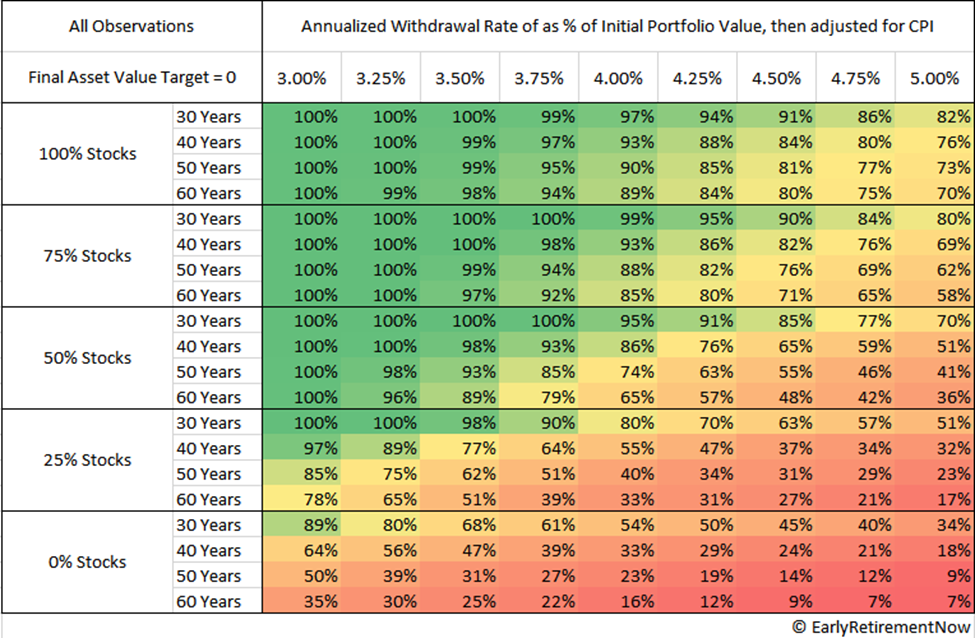
That percentage tells you how sustainable your plan might be. If it's under 4%, the probabilities show a higher success rate. Above 5%, decreases your success rate.
The chart below depicts this clearly.
Step 4: Revisit Annually
Your withdrawal strategy isn't a one-time calculation. It should be reviewed every year to account for market returns, inflation, and changing spending needs. This ongoing adjustment keeps your retirement income plan on track.
Retirement Spending Phases
It's not uncommon to go through different phases of spending in retirement. One common trend that is observed is called the "Go Go, Slow Go, and No Go." When you first retire, you may have higher spending and therefore a higher withdrawal rate. However, most retirees tend to spend less the further they get into retirement. The graphic below shows this in more detail.
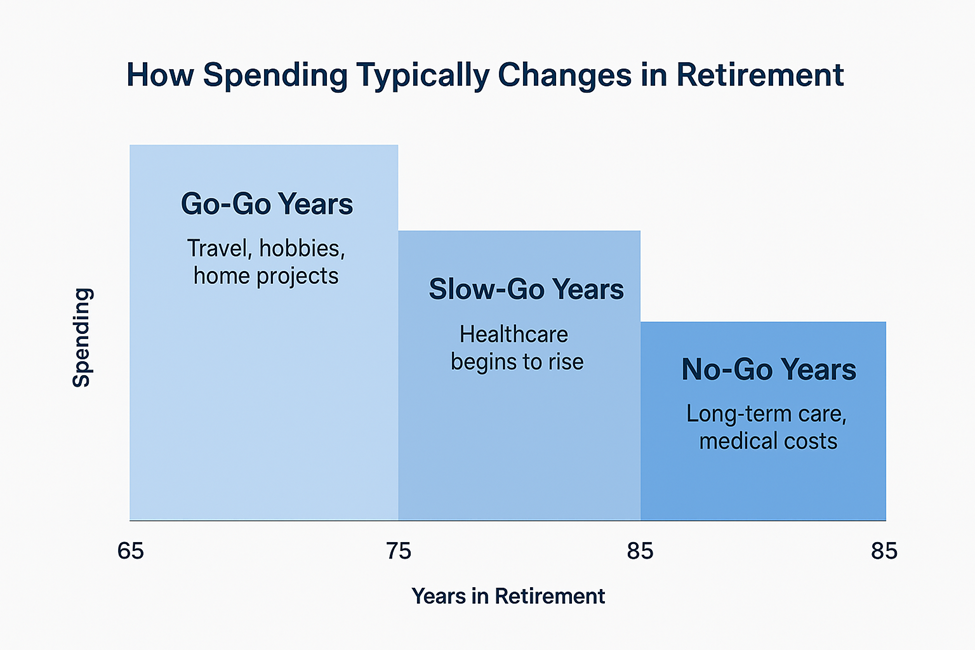
However, monitoring your withdrawal rate and spending on an annual basis is still critical, as maintaining a high withdrawal rate can break down your plan if continued for many years.
Setting Retirement Income Guardrails
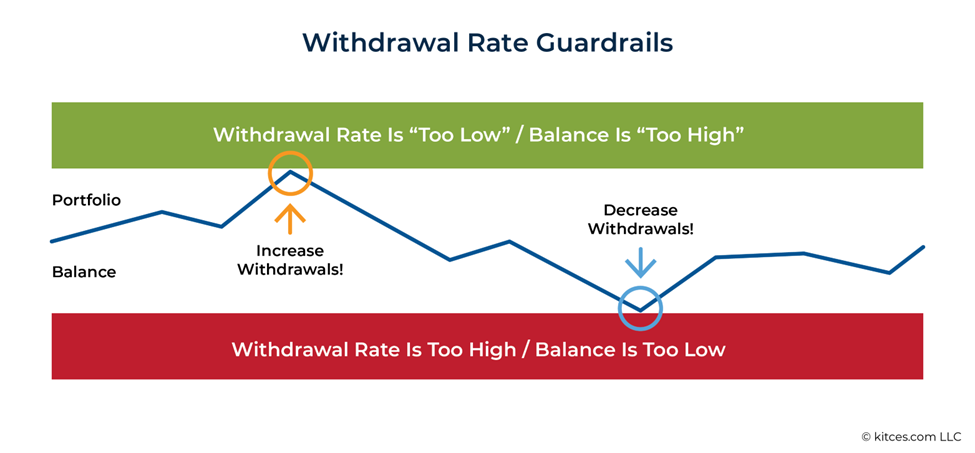
Even with a solid withdrawal plan, markets don't move in straight lines. Guardrails give you a built-in system for knowing when to adjust your income so you can stay confident through ups and downs.
The idea is simple — you set a target withdrawal rate (say 4%) along with upper and lower "guardrails." If markets rise and your portfolio grows, you can give yourself a raise. If markets fall and your withdrawal rate drifts above your upper limit (say 5.5%), you temporarily tighten spending until things recover.
This approach, often called a dynamic withdrawal strategy, keeps your plan flexible without constant worry. It helps prevent overreacting to short-term swings while ensuring you're not drawing too much when markets are weak.
Guardrails turn your retirement plan into a living system. Instead of sticking to a fixed number every year, your income naturally adjusts to what the market and your lifestyle allow — keeping your money working longer and your retirement more stable.
Quantitative vs Qualitative: What do you want to get out of retirement?
We recommend some intentional thinking on how you want your retirement to look like. We've seen many people skip past this part, and a few weeks after their last day, they look around and ask: "Now What?"
When we help guide people into and through retirement, we always look at this through the lens of their life goals. Maybe you'd like to travel, volunteer with an organization you love, or simply play golf (Which I am all on board for). Having a purpose and vision for retirement often allows you to enjoy this time at a deeper level. Understanding your goals can also better solidify the financial approach you take when creating a retirement plan.
Step 3: Build a Reliable Retirement Income Plan
Once the paycheck stops, your focus shifts from accumulating assets to generating income. You may have assets spread across many accounts. Creating a system for where you will generate income is paramount -- And doing so in a tax efficient manner.
Key Considerations
Sources of Income: Identify all sources—401(k), IRAs, Costco Deferred Compensation, Social Security, pensions, and other savings. Consolidating your accounts to one platform is often a very helpful way to approach this.
Withdrawal Strategy: Decide which accounts to draw from first. Generally, taxable accounts are used first, then tax-deferred accounts, and finally Roth accounts. One simple way to do this is to set up an automatic monthly withdrawal. An industry rule of thumb is to aim for <4% withdrawal rate from your portfolio each year.
Tax Planning: Retirement can shift your tax bracket significantly. Coordinating withdrawals, Social Security, and Roth conversions can minimize overall taxes.
- Medicare premiums are based on your Modified Adjusted Gross Income. Being strategic in understanding how the income you take will affect your premiums is important, because you can needlessly be pushed into a higher premium bracket.
- It's not uncommon for Costco professionals to have large 401ks through steady contributions or the strong performance from COST stock. Being strategic in converting parts of these large 401ks to Roth IRAs can be a tactical way to reduce your overall tax liability in retirement and provide tax diversification.
Example: A retiree with both a 401(k) and taxable brokerage account might withdraw from the brokerage first while letting tax-deferred accounts grow, converting some to Roth accounts gradually before RMDs begin at age 73.
It's also important to understand what the net amount you will need each month looks like. $10k withdrawn from an IRA or 401k does not mean you get $10k in your bank account. There will be taxes withheld on your withdrawal based on your tax rate.
If your monthly expenses are budgeted out to $8k a month and you are in the 20% tax bracket, a $10k IRA withdrawal will work great. ($10k withdrawal - 20% taxes = $8,000 net)
Step 4: Invest for Income and Stability
Your approach to investing in retirement is different than during your accumulation years. You are now withdrawing income, which increases sensitivity to market swings. Having an investment allocation that you are comfortable with and suits your retirement goals is mission critical.
Strategies for Retirees
- Lower Risk Threshold: Most folks we see entering retirement have a heavy weighting toward stocks. This is a good time to re-evaluate the risk you feel comfortable taking and reduce if needed by introducing bonds.
- Diversification: Ensure the stock portion of your portfolio is well diversified (And not concentrated in one stock)
- Tax Efficiency: Hold income-generating assets in tax-deferred accounts where appropriate and growth-oriented assets in Roth accounts.
- Align With Goals: Your portfolio should provide income streams to support your lifestyle priorities, such as travel or charitable giving.
Step 5: Social Security Planning
Social Security can be one of your most important sources of income. Planning when to claim is critical:
- Claiming Early vs. Late: Benefits can be claimed at 62, but delaying until 70 maximizes your monthly payout.
- Spousal and Survivor Benefits: Married couples should evaluate the timing of claims to maximize household benefits.
- Tax Considerations: Up to 85% of Social Security benefits can be taxable depending on income. Smart planning can minimize this.
Choosing when to take your social security is dependent on your life goals. Some people say, "I've been contributing to this for decades, I'd like my money as now as possible." This can make sense.
- Some prefer to claim early at 62 to enjoy funds during more active years.
- Others delay until 70 to lock in higher benefits for life.
Step 6: Healthcare Coverage
Healthcare is often the largest retirement expense. Costco benefits, combined with Medicare, can help you manage costs:
- Estimate Health Care Costs: If you retire before age 65 and do not have continued health insurance benefits, you will need to find a healthcare solution during that time. Washington Health Plan Finder is a good tool to estimate your pre-Medicare insurance cost.
- Medicare Enrollment: Sign up at 65 to avoid late penalties. Evaluate supplemental insurance options to cover gaps.
- Health Savings Accounts (HSAs): Use pre-tax contributions to cover medical expenses in retirement. After enrolling in Medicare, you can no longer contribute, but the funds continue to grow tax-free.
- Long-Term Care: Medicare does not cover extended nursing home or in-home care. Consider insurance or dedicated savings for these potential costs.
Step 7: Estate and Legacy Planning
Estate planning ensures your assets are managed according to your wishes and minimizes the burden on loved ones:
- Wills and Trusts: Keep documents updated and consider a living trust to avoid probate and maintain privacy.
- Beneficiary Designations: Ensure all accounts, including retirement and insurance, have current beneficiaries.
- Power of Attorney and Healthcare Directives: Designate trusted individuals to make financial and medical decisions if you become incapacitated.
- Gifting Strategies: Use annual gifting limits ($19,000 per recipient in 2025) to reduce estate size and pass wealth efficiently.
- Washington State Estate Tax: Planning is especially important under current estate tax rules, even for mid-sized estates.
If your estate is worth more than $3 million, it may be subject to the Washington State estate tax. For married couples, one effective way to reduce that exposure is by setting up a disclaimer trust, which can effectively double the exemption to $6 million.
A well-structured estate plan can make a significant difference in protecting your wealth and ensuring more of it passes to your family instead of the state. As you move into retirement, reviewing and updating your estate plan is just as important as managing your investments or planning your income.
Step 8: Creating Your Retirement Checklist
Use this checklist to ensure you have covered the major aspects of retirement planning:
Financial Planning & Income
- Build a clear income plan showing which accounts to draw from first.
- Develop tax-efficient withdrawal and Roth conversion strategies.
- Maximize 401(k) contributions and employer match while still working.
- Review Deferred Compensation eligibility and strategy.
- Diversify ESPP and Costco stock holdings (Utilize NUA strategy if applicable)
Social Security & Healthcare
- Determine optimal Social Security claiming age.
- Evaluate spousal and survivor benefit strategies.
- Enroll in Medicare and review supplemental coverage.
- Maximize HSA contributions before retirement.
Investing & Risk Management
- Shift portfolio toward income stability and risk management.
- Maintain adequate diversification across asset classes.
- Align investments with personal goals and cash flow needs.
Estate & Legacy
- Update wills, trusts, and beneficiary designations.
- Establish powers of attorney and healthcare directives.
- Review Washington estate tax exposure and gifting strategies.
Lifestyle Planning
- Define personal goals: travel, volunteering, hobbies, family time.
- Align retirement budget with your intended lifestyle.
- Consider phased retirement or part-time work if desired.
Conclusion
Retirement is a personal journey, and the choices you make today will shape your experience for decades to come. By combining a thoughtful review of your goals with careful planning of income, taxes, investments, Social Security, healthcare, and estate matters, Costco professionals can retire with confidence.
Taking the time to understand both your goals and financials ensures that retirement is not just a financial milestone but a fulfilling next chapter in your life.
Costco Tailored Financial Education Here
Trey Gevers CFP®
Trey Gevers is a CERTIFIED FINANCIAL PLANNER™ and managing partner at Gevers Wealth in Issaquah, WA, specializing in helping people navigate retirement with clarity and confidence. He's known for turning complex financial strategies into plans that are actually easy to understand — because he believes a great plan should build your future and let you enjoy the life you're living right now.
Continue Reading
Discover additional articles to help you stay informed and make thoughtful financial decisions over time.
.jpg)









.png)

.jpg)

























Book a Free Assessment Today
Set up a relaxed introductory call to see if we are a good fit.