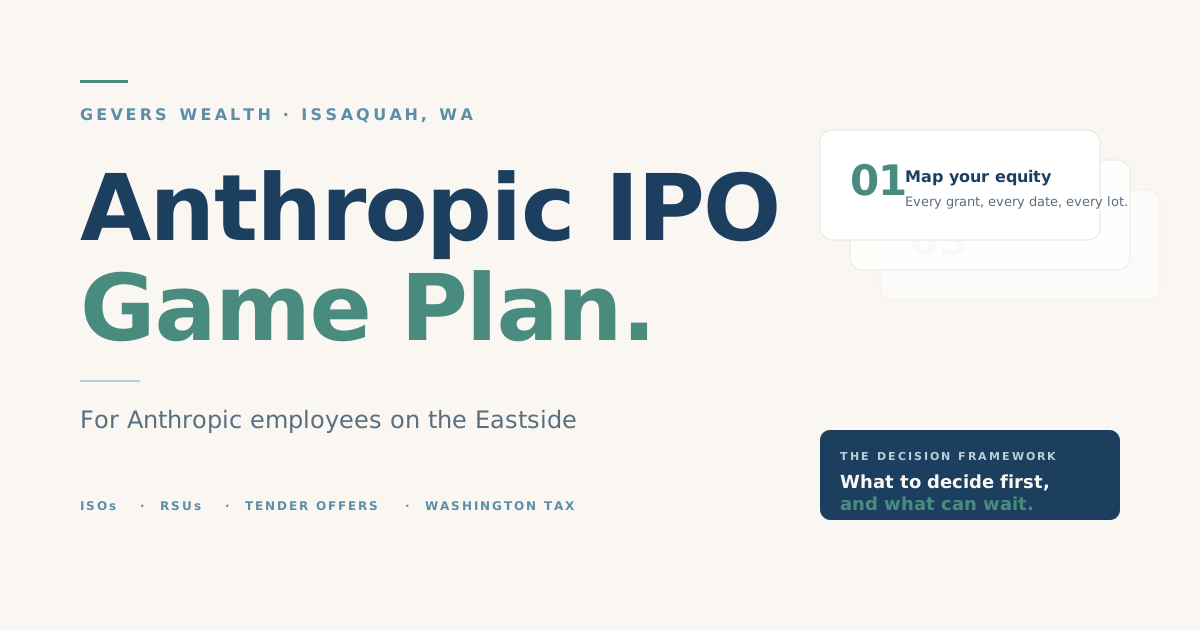
Your Anthropic IPO Game Plan: what to decide first, and what can wait.
If you're an Anthropic employee on the Eastside, chances are you've been working so hard on the mission at hand that you haven't spent adequate time focusing on your finances. Now you look up, an IPO is closing in quickly, and there are some big decisions to make. We just walked many local SpaceX employees through this same process, and we specialize in the Washington state tax picture, including the new 9.9% state income tax that starts in 2028. This guide is the framework we use to think it through.
- Which equity decisions become irreversible once you exercise, sell, or trigger a taxable event?
- What does a smart sequencing plan look like across ISOs, NSOs, RSUs, and ESPP shares?
- Where do contractual quirks like ISO tainting provisions hide, and why do they matter?
- What should an Anthropic employee actually do in the next 30 days, by grant type?
What we know from the outside looking in.
If you're reading this, chances are you work at Anthropic and probably know more about this than we do. Here's the public information:
Anthropic hasn't confirmed a filing date. In April 2026, Amazon committed to invest up to $25 billion. In September 2026, Anthropic closed a reported $65 billion funding round at a valuation near $965 billion, described in public reporting as likely the last venture round before an IPO. In June 2026, the company signed a 113,000 sq ft lease at Dexter Yard North in Seattle's South Lake Union, anchoring a major Seattle expansion on top of the engineering office it opened here in 2024.
If you're one of the engineers, researchers, or operators building that story from Redmond, Bellevue, Sammamish, or Issaquah, you're probably thinking "I should figure this out soon."
Here's what we've found doing this work: most of the decisions you're facing are much easier to make when you look at them through the life goals that you have.
The reason people make expensive mistakes around IPOs is rarely a lack of intelligence. It's poor sequencing. They focus on the exciting decisions like how much to sell, before making the critical ones like which shares can even be sold, and when. They optimize for tax before they've dealt with investment risk. They get paralyzed by optionality and end up making no decision at all.
This article was created to help you lay out a framework for how to think about these decisions. Each decision below deserves its own deep dive, and we'll cover them in follow-up guides. But before any of those matter, you need to understand which decisions are on the critical path, which can wait, and what a first 30 days actually looks like by grant type.
The equity mix you're likely navigating.
Most Anthropic employees are looking at some combination of the following:
- ISOs. Tax-advantaged options with AMT implications, qualifying disposition rules, and often contractual provisions in the grant documents that can meaningfully change how a partial sale affects the rest of your grant.
- NSOs. Simpler than ISOs, no AMT complexity, but the spread at exercise is ordinary income. Still consequential in high-income years.
- Double-trigger RSUs. Common at late-stage private companies. They vest on schedule, but the income event is deferred until a liquidity event, typically the IPO. When the second trigger fires, everything vested to date is taxed as ordinary income in a single year.
- ESPP shares. If Anthropic offers one, ESPP shares can be a meaningful part of the overall compensation picture. Qualifying versus disqualifying disposition status matters for tax treatment at sale.
Each of these has different tax treatment, different optimal sequencing, and different decisions that must happen before an IPO window opens. That's before you layer in lockup periods, blackout windows, insider designations, and the timing of when things actually become liquid.
Reversible versus permanent.
Not all decisions are equal. Some you can adjust later. Jeff Bezos often talks about decisions with two-way doors and one-way doors. We need to be extremely careful with the decisions that have one-way doors.
Once done, it's done.
- ISO exercise decisions. Once you exercise and create an AMT bill, you can't un-exercise. The cash is out, the tax clock has started, and the holding period has begun.
- ISO qualifying disposition timing. To get long-term capital gains treatment on ISOs, you need to hold shares one year after exercise and the grant must be two years old before you sell. You can't retroactively start the clock.
- Disqualifying dispositions. Some option grants contain contractual provisions where a disqualifying disposition on part of a grant affects tax treatment on the rest. Read your plan documents carefully before selling any ISO shares.
- Post-termination exercise window. If you leave the company, you typically have a defined window, often 90 days, to exercise vested options before they expire. Missing this is one of the most commonly ignored time bombs around liquidity events.
Adjustable as you go.
- How much to sell post-lockup. The total amount and the timeline can be refined as market and life conditions change.
- Which tax lots to prioritize. Lot selection at sale is a decision you make when you actually sell, not months in advance.
- What to invest proceeds in. Allocation decisions can be made thoughtfully over months post-IPO.
- Whether to hold some Anthropic long-term. Often a dynamic decision, but not a time-critical one before the window opens.
The irreversible decisions need to happen before the IPO window opens. The reversible ones can be refined as you go, though all else equal, the sooner you plan the better.
What matters now, what can wait.
Do these before the IPO (or very soon after)
Map your complete equity inventory
We've found this to be very helpful for the tech professionals we've worked with. Planning is much easier when you're organized.
Take stock (no pun intended) of your shares. Every grant, every grant date, every strike price, vested versus unvested counts, ISO versus NSO designation, ESPP participation history and qualifying status by lot, any prior AMT payments and carryforward credits. Most people have a rough sense. A full picture usually reveals more concentration than expected. For many employees, equity compensation may represent a significant portion of their overall financial picture, so it can be worth understanding its value, risks, and potential tax implications.
We can build this out for you so you have it all in one place.Understand your lockup, blackout, and selling dynamics
A standard 180-day lockup is the market default, but recent deals have used everything from staggered releases to price-triggered early unlocks. Beyond the lockup, quarterly blackout periods will typically block another five to nine weeks per quarter. If you're a pre-clearance individual, add internal approval steps. A Rule 10b5-1 plan can automate this, but only if put in place while you're free to trade.
Make your ISO exercise decisions
The most technically complex and time-sensitive decision for most employees with meaningful ISO holdings. At a private-company valuation near a trillion dollars, almost any ISO exercise will trigger AMT, often a significant amount. The question is whether to exercise some or all of your ISOs before an IPO, and if so, how many, which lots, and with what AMT strategy. This interacts directly with your tax year, your cash position, the qualifying disposition clock, and your AMT credit strategy for years afterward.
Read your plan documents for contractual quirks
Some company option grants include provisions that make one disqualifying disposition affect the tax treatment of the entire grant. Others have acceleration clauses tied to a change of control. Others limit tender participation to specific tranches. Before any move involving your ISOs, including tender participation, you need to know which shares would be qualifying and which would not, and what your plan actually says about partial sales.
These can come later, but should still get planned
Build your selling framework
How much to sell, over what timeline, using what rules. Important, but not as time-sensitive. You have until lockup expiration to finalize this. The key is that the plan is written down before the lockup expires, not after. Decisions made under the pressure of watching a stock move are worse than decisions made in advance.
Tax optimization on the sell-down
Lot selection, charitable strategies, tax-loss harvesting, donor-advised funds, exchange funds. These are powerful tools, but they come after you've determined investment goals and risk tolerance. Tax strategy that wags the dog is how people end up with a suboptimal financial outcome that happened to have a lower tax rate.
Investment allocation of proceeds
Once shares are liquid and proceeds start coming in, what do you invest them in? This depends on your time horizon, your goals, your other assets, and how much Anthropic you're keeping.
A practical checklist, by grant type.
Six moves that may make sense to consider this fall.
- Calculate the approximate bargain element on your vested ISOs at the current 409A valuation. Bargain element = (current 409A value − strike price) × number of shares.
- Estimate your potential AMT bill at different exercise scenarios. Rough numbers help; precision comes later.
- Identify whether any of your existing ISO lots are already qualifying dispositions (exercised more than one year ago, grant more than two years old).
- Read your option grant agreement in full for any tainting, acceleration, or partial-sale provisions.
- Decide whether to exercise any ISOs pre-IPO, and if so, how many and which lots.
- Confirm you have cash available to fund both the exercise cost and the estimated AMT bill.
Simpler, but still worth attention.
- Understand your net spread and what ordinary income recognition would look like at exercise.
- Identify any NSOs that are deep in the money with limited remaining option leverage value.
- Consider whether exercising any NSOs is desired.
The withholding trap is the one to watch.
- Understand your withholding election. The standard 22% supplemental rate may not be enough for a large IPO-triggered event. Many high earners may want to elect 37%.
- For RSUs already vested (single-trigger): you own the stock. No action required before IPO, but include them in your selling plan.
- For double-trigger RSUs: model the ordinary income event at the IPO. This could be the biggest tax bill of your life so far.
Three things worth doing regardless of grant mix.
- Build or update your full equity map with all grants, dates, types, strike prices, and vested versus unvested counts.
- Confirm your insider or pre-clearance designation status.
- Get a rough sense of your AMT credit carryforward from any prior ISO exercises.
What we can accomplish before the window opens.
- Build a full equity exposure map: vested, unvested, implicit career risk
- Define what this liquidity is for and what success looks like 5 to 10 years out
- Identify irreversible decisions and quantify worst-case downside
- Identify your biggest tax risks: AMT exposure, concentration, Washington capital gains
- Run scenario models: exercise timing, AMT ranges, sell sequencing
- Integrate the IPO plan with your broader financial picture
- Finalize your sell framework for the first 12 months
- Holistic tax strategy: AMT recovery, tax lot selection, capital gains deferment
- Set the IPO-to-post-lockup action calendar
Living on the Eastside adds a wrinkle worth knowing.
Washington has no state income tax (for now), which is one of the reasons the Eastside has become such a wealth-building region. We do have a capital gains tax now, though: 7% on long-term gains above roughly $270,000 per year, with an additional 2.9% surtax on gains above $1 million, for a total of 9.9% at the top. For an Anthropic employee selling into an IPO or a large tender, that surtax will apply to most of the transaction.
The federal picture is heavier still: long-term capital gains at 20%, plus the 3.8% net investment income tax on high earners, plus AMT considerations for ISOs. Stack it all together and the difference between a well-sequenced and rushed exit may be significant on a large position.
However, Washington will have a state income tax starting in 2028. If you have a substantial amount of ISOs or NSOs, it may make sense to approach those in 2026 and 2027, as the tax implications could be substantially higher starting in 2028.
From concentrated equity to structured liquidity.
A senior engineer with over 90% of net worth tied to one company.
Consider a senior engineer at a late-stage private AI company. Between vested and unvested ISOs, NSOs, ESPP shares, and double-trigger RSUs, over 90% of their net worth sits inside one company. An IPO is rumored but not confirmed.
Rather than reacting to headlines, the work starts with quantifying total exposure, including unvested grants and implicit career risk. From there, exercise sequencing, AMT thresholds, and post-lockup sell scenarios get modeled across several valuation outcomes. Before liquidity arrives, the ISO roadmap, AMT guardrails, tax-optimization strategy, and diversification glide path are already defined.
When the window opens, execution follows a written plan. The engineer knows what to sell, when, and why, before market pressure or blackout windows narrow the options.
Doing nothing because it felt too complicated.
Across the tech professionals we've worked with through liquidity events, the most common expensive mistake isn't a bad tax decision or a poorly timed sale. It's doing nothing because it felt too complicated.
The people who do best aren't necessarily the ones who optimize every variable. They're the ones who made a plan, even an imperfect one, before the window opened and executed it without emotion. The people who do worst are the ones who watched the stock, kept telling themselves they'd figure it out soon, and then made decisions reactively when they were under pressure.
The point of planning isn't to predict what Anthropic will do after an IPO. It's to make sure that whatever happens, you're not surprised by it.
If Anthropic does file in 2026 or 2027, you have months, not years, before the first sell window opens. That's enough time to do this right.
We're up the road in Issaquah.
Our office sits on the I-90 corridor in Issaquah, close to the Bellevue, Redmond, Sammamish, and Issaquah neighborhoods many Anthropic employees call home. We spend our days with people at exactly this moment: concentrated equity that may soon become liquid, a tax picture that only makes sense grant by grant, and a life that suddenly holds more options than it did a year ago.
We want to build a plan that shows you your options.
To close this out on a high note: Congratulations! This is an exciting time in your career and has the potential to be life altering. Good luck.
Schedule a conversationGevers Wealth Management is an SEC-registered investment adviser based in Issaquah, WA. This article is for educational purposes only and is not tax, legal, or investment advice, nor an offer or solicitation to buy or sell any security. Gevers Wealth Management is not affiliated with Anthropic, PBC. References to Anthropic's business plans, valuations, funding rounds, office expansions, and any potential public offering are based on public reporting and company announcements available as of 2026 and are subject to change. Nothing in this article should be interpreted as a prediction of, or opinion on, whether or when Anthropic will pursue an IPO. The illustrative scenario above does not represent any actual client and is provided for educational purposes only; all facts have been fictionalized. References to option plan features, ISO tainting provisions, vesting mechanics, blackout policies, and post-termination exercise windows are general in nature and vary by employer; confirm your specific plan terms against your actual grant agreements and plan documents. Washington State tax rules referenced, including the 2028 income tax under SB 6346 (signed March 30, 2026) and the existing capital gains tax and 2.9% surtax, are current as of publication and subject to legislative and legal change. Strategies mentioned here, including Rule 10b5-1 plans, ISO and AMT planning, donor-advised funds, tax-loss harvesting, exchange funds, tender offer participation, and diversification approaches, carry their own eligibility requirements, risks, and trade-offs, and aren't right for everyone. Individual grant types, tax situations, and lockup schedules vary; consult your own tax and legal advisors before acting. Investing involves risk, including possible loss of principal. Past performance does not guarantee future results.







.png)

.jpg)