Inflation in retirement: our take on the WSJ's Retirement Rookies.
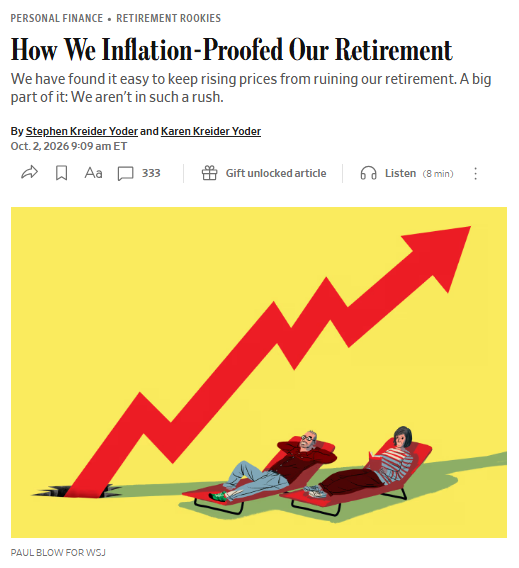
This month's Retirement Rookies column in The Wall Street Journal features Stephen and Karen Kreider Yoder, four years into retirement, explaining why rising prices barely register for them anymore.
It's a great read. And it gets at something many inflation articles skip entirely.
Their defense against inflation isn't a fund or a product. It's flexibility. They gave up the car. They travel midweek, fix their own appliances, and turn a farmer's discarded fruit into jam. In retirement, time has started doing the work money used to do.
Here's what we think they got right, and where we'd push the conversation further.
What they got right
Your inflation rate isn't the headline number.
The Consumer Price Index tracks a basket of goods for the average consumer. Your basket is yours. A couple without a car barely feels gas prices. A couple who flies on decades of saved miles barely feels airfare. Retirees also have something workers don't: the time to shop around, travel off-peak, and wait.
They separated short-term money from long-term money.
According to the column, the Yoders keep conservatively invested funds for near-term spending and stocks for the long run. That structure can matter. It may reduce the need to sell stocks during a downturn to cover groceries, while the long-term portion keeps the potential to grow faster than prices over time.
They stopped watching the markets.
Steve no longer follows the daily financial news. For someone who worried about money his whole life, that peace of mind is a real return, even if it never shows up on a statement.
Where we'd push further
Not every retiree wants to live like newlyweds again.
Many of the people we work with spent 30 years building something so they could travel, help their kids, and stay in the house they love. "Don't buy it" works for a $7 latte. It works less well for the costs you can't opt out of.
Some costs don't respond to willpower.
Health care, insurance, property taxes, and home repairs don't get cheaper because you decide to want them less. For many retirees, these are the line items that matter most, and they're the ones a plan needs to account for directly.
Inflation shows up on your tax return, too.
Federal tax brackets adjust for inflation every year. Some important thresholds don't. The income levels that determine how much of your Social Security is taxable were set in 1984 and 1993 and have never been adjusted. The thresholds for the 3.8% Net Investment Income Tax ($200,000 single, $250,000 married filing jointly) haven't moved since 2013. As withdrawals and required minimum distributions rise over time, more retirees may cross these lines without actually being any better off in real terms.
Social Security is one of the few built-in inflation hedges.
Benefits receive an annual cost-of-living adjustment. For someone with a full retirement age of 67, waiting from 62 to 70 increases the monthly benefit by roughly 77%, and every future adjustment builds on that larger base. Delaying isn't right for everyone. Health, cash flow, and other income all factor in. But it may be one of the more meaningful inflation decisions a retiree makes.
Time compounds against you, too.
At 3% annual inflation, prices roughly double in 24 years. For someone retiring at 65, that's a retirement that may last into the late 80s or beyond. Planning for today's prices isn't enough.
About that "100%"
In the column, Steve asks his planner whether they'll run out of money before they die, and the answer is 100%. To be fair, it came with a condition: as long as they keep spending the way they do.
That condition is the whole game.
We'd frame it differently. Over a 30-year retirement, nobody can promise certainty. Markets, tax laws, and health don't cooperate on schedule. What a plan can do is show you a realistic range of outcomes and set guardrails in advance: when to trim spending if markets fall, and when you've earned room to spend more if they rise. That's what may let you stop worrying about inflation, not a single number.
The point of the plan
Frugality you choose is freedom. Frugality you fall back on because you don't know your numbers is just fear with a budget.
The Yoders appear to have the first kind. A good plan tells you which kind you have. And if the answer is that you can afford the $7 coffee, it should give you permission to buy it.
Find out which kind of frugal you are.
A relaxed conversation about your spending, your income sources, and how inflation fits into your plan.
Book your free assessmentThis article is for educational purposes only and is not individualized investment, tax, or legal advice. It reflects commentary on a published article and should not be relied upon as a summary of it; readers should consult the original. Tax and Social Security figures reflect current law as of the date of publication and are subject to change. Whether any strategy discussed is appropriate depends on individual circumstances, including income, health, tax situation, and goals. Investing involves risk, including possible loss of principal. No strategy can guarantee a particular outcome or protect against loss, including loss of purchasing power due to inflation.
Gevers Wealth Management is independent of and is not affiliated with, endorsed by, or sponsored by The Wall Street Journal, Dow Jones & Company, or any individual referenced in this article.
Gevers Wealth Management, LLC, a Registered Investment Advisor with the Securities and Exchange Commission. Registration does not imply a certain level of skill or training.
.jpg)






.png)

.jpg)