
The WSJ Just Ranked Costco's 401(k) Among America's Most Generous. If It's Your Plan, Here's the Fine Print That Matters.
This week the Wall Street Journal surveyed the most generous 401(k) plans in America — Boeing, Visa, Southwest, the automakers — and led the whole piece with Costco. Not because of a flashy match rate, but because of a quieter mechanism: Costco puts in 4% of your pay after one year of service whether or not you contribute a dime, and that figure climbs with tenure to 9% at 25 or more years.
For context, the Journal cited Vanguard data showing the average company match runs about 4.7% of salary — and only 6% of plans promise 7% or more. A 25-year Costco employee is receiving 9% automatically, plus the $500 match, on top of the industry's highest hourly wages. That combination is why, as Costco's CFO has acknowledged, many thousands of the company's hourly workers have crossed $1 million in their accounts.
Annual company contribution as a share of pay, paid whether or not you contribute. Endpoints per WSJ, July 2026; intermediate tiers approximate — see your Summary Plan Description.
We're a wealth management firm in Issaquah, Costco's hometown. Our office is a stone's throw away from the world headquarters. We've worked with many Costco professionals over the years, and we've found that your T Rowe Price 401k account is your flagship component of your 401k plan.
We help long-tenured Costco employees understand what to do next with their 401k when they are nearing or entering retirement.
The importance of the generous company contribution
Most 401(k) generosity requires the employee to act: contribute 6%, get 6%. Miss a year of contributions — a divorce, a medical crisis, a new roof — and you lose the match too.
Costco's design severs that link. The 4%–9% contribution is nonelective: it arrives regardless of what you put in. Over a 30-year career, that means the company was compounding money on your behalf through every rough patch when you couldn't spare a dollar of your own. It's the closest thing the modern retail industry has to the pensions it abandoned — the WSJ notes Ford and GM had to negotiate their way to a similar 10% nonelective through the UAW. Costco just does it. I've said it many times, but this is another reason I admire Costco's corporate culture, as they are looking out for their employees.
Run the arithmetic on a top-of-scale employee earning roughly $68,000 a year at $32.90 an hour: the 9% tier alone is about $6,100 annually in company money, invested and compounding, before you contribute anything. That is a material component behind the millionaire-cashier phenomenon that was just on the front page of The Journal.
Generous accumulation creates a tax problem later. Nearly all of that company money is pre-tax. A seven-figure pre-tax balance left untouched becomes large forced withdrawals when required minimum distributions begin at 73 — potentially pushing you into higher brackets and raising Medicare premiums. The fix is deliberate: Roth conversions during the low-income years between your last paycheck and Social Security. The more generous the plan was to you, the more valuable that window becomes.
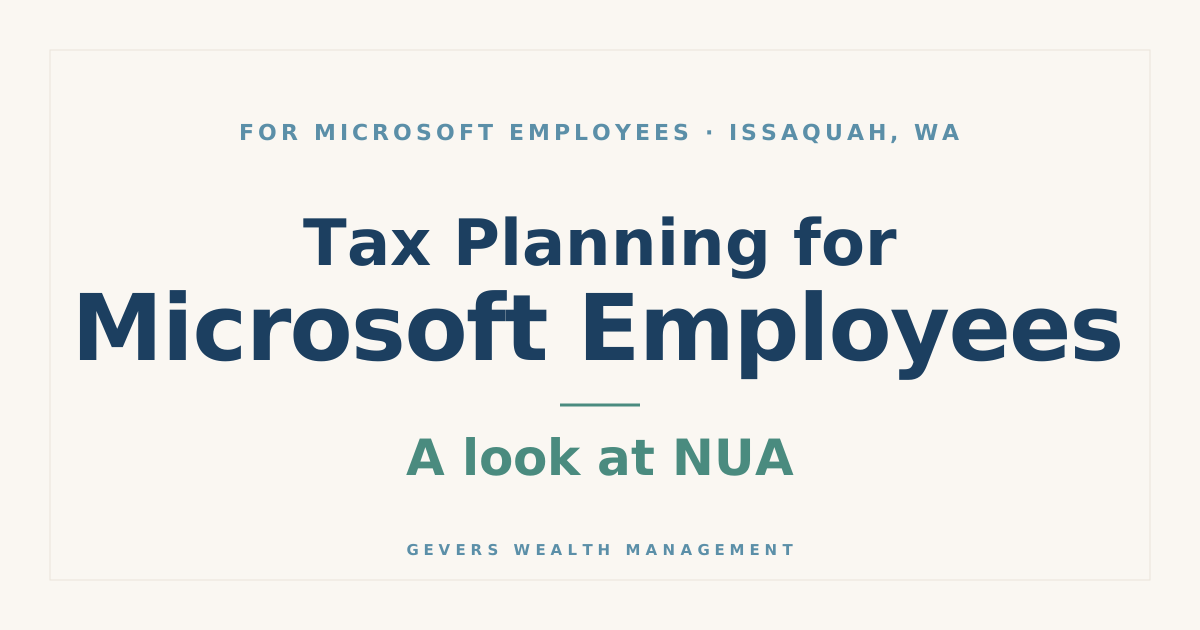
The plan built your balance; it also concentrated it. Long-tenured employees often hold heavily appreciated Costco stock from the pre-2016 era when the plan allowed 100% company stock. Before any rollover, that stock should have a net unrealized appreciation (NUA) analysis — a one-time, irreversible tax election that may be able to shift decades of gains from ordinary income rates to capital gains rates. Doing this can potentially provide favorable tax treatment. Roll it to an IRA first and the opportunity is permanently gone. We covered this in depth in our response to the Journal's earlier profile of Costco's millionaire cashiers.
You built up a 401k nest egg, what's next?
If you've spent 30 years making contributions, your financial life probably feels like it's on autopilot now. As you near retirement, taking some time to be intentional about how you will access your money, diversify your COST stock, and pay the least amount of tax as possible is important.
If this is your plan
Gevers Wealth works with long-tenured Costco professionals throughout the Seattle area and nationwide. Our Costco Retirement Review walks through the retirement-date math, the NUA analysis, the rollover decision, and the gap-year tax plan — with your actual numbers, not national averages.
The company took care of the saving. Let us take care of the rest.
How much does Costco contribute to employee 401(k)s?
After one year of service, Costco contributes 4% of pay regardless of employee contributions, rising with tenure to 9% at 25+ years of service, plus a match of up to $500 per year on the first $1,000 an employee contributes.
Is Costco's 401(k) really one of the best in America?
The Wall Street Journal featured it among America's most generous plans in July 2026. Its strength is the automatic nonelective contribution — most plans require employee contributions to earn the average 4.7% match, while Costco pays its 4%–9% unconditionally.
What is a nonelective 401(k) contribution?
Company money deposited into your account whether or not you contribute yourself. Costco's tenure-based contribution works this way, unlike a match that depends on your own deferrals.
Gevers Wealth is not affiliated with Costco Wholesale Corporation, T. Rowe Price, or the Wall Street Journal. Plan details referenced are based on public reporting and plan filings and may change; consult your Summary Plan Description. This content is educational and not individualized tax, legal, or investment advice.




.png)
.jpg)