Direct Indexing for Tech Professionals: Diversify Concentrated Stock Tax Efficiently
Holding a big block of company stock? See how Issaquah tech professionals use direct indexing to diversify while managing federal and WA capital gains tax.

If you work in tech, the odds are you have a highly appreciated concentrated stock position. It's ballooned in size over the years, and you've finally taken a deeper look at it and thought, "I probably need to do something about this."
It's a fantastic problem to have. We've worked with many tech professionals who have seven-figure positions accumulated over years of service, and this is the number one question we get asked:
How do I diversify some of this stock without getting killed in taxes?
That's where direct indexing and tax-loss harvesting come into play.
What is direct indexing?
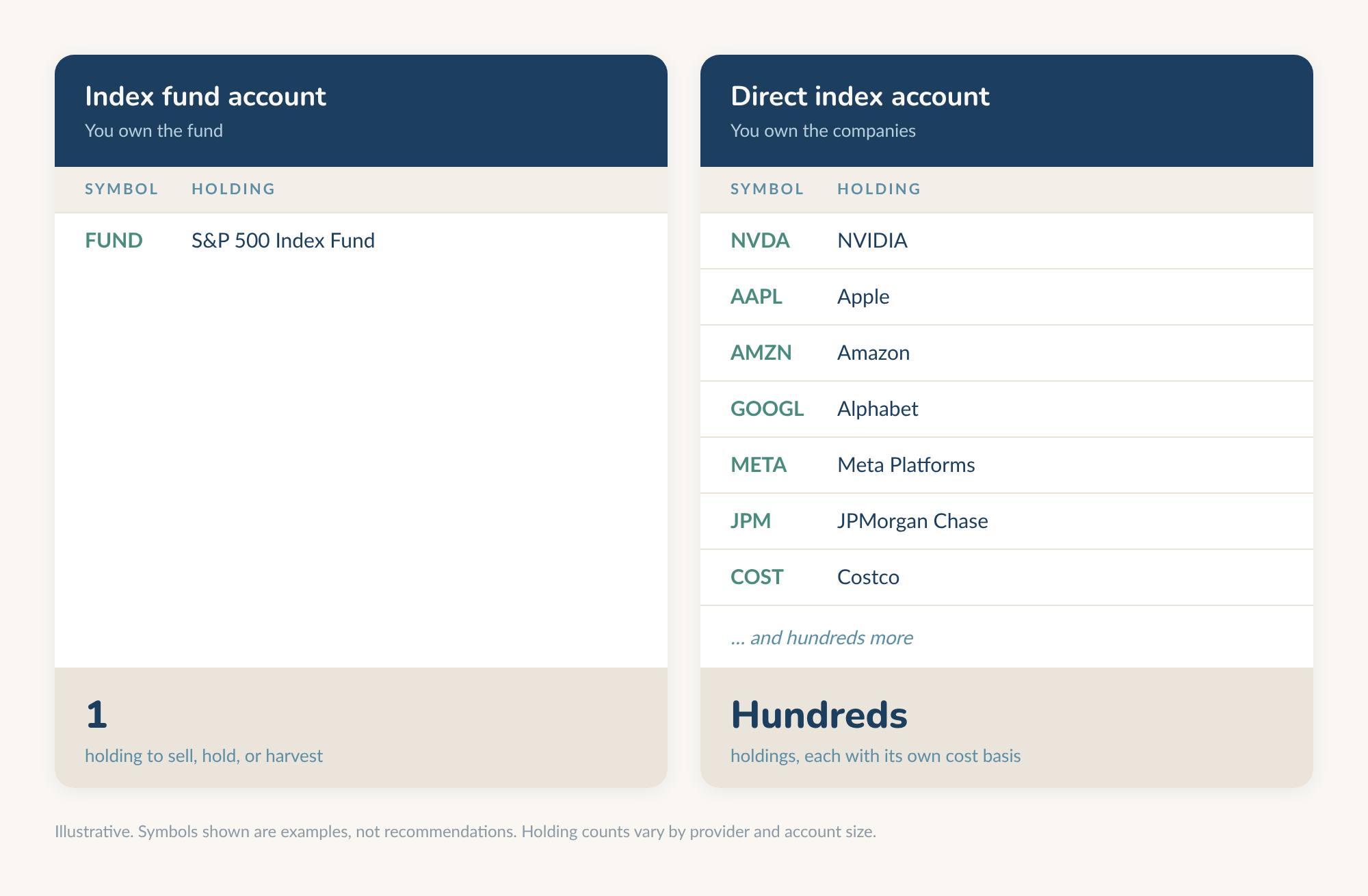
If you want diversified, broad exposure to the stock market, you typically buy an index fund. For example, you might buy an S&P 500 index fund so that you own all of the companies in the S&P 500.
But what you actually own is the fund. Your account shows one holding.
Direct indexing flips that. Instead of buying the fund, you buy the stocks inside the index directly, in your own account. Most providers hold a representative sample rather than every single name (Aperio's sample S&P 500 portfolio holds 350 stocks), built to track the index closely.
So why does it help to own the stocks individually rather than the fund?
Tax-loss harvesting
Tax-loss harvesting means selling positions that have declined, capturing the loss for tax purposes, and replacing them with similar exposure so the portfolio stays on plan. A direct index does this at the individual-stock level, all year long, not as a December cleanup.
Here's why that matters: the index being up tells you almost nothing about the stocks inside it. In every calendar year from 1998 through 2025, some stocks in the Russell 3000 lost value, including years like 2003, 2013, and 2019 when the index itself gained more than 30%. An index fund owner can't touch those losses. They're buried inside the fund. A direct index owner can harvest them and stay invested.
Those harvested losses can then offset realized gains elsewhere, including the gains you create when you sell down a concentrated stock position.
One framing matters more than any mechanic: the value here is measured after tax. A direct index isn't trying to outguess the market. The potential benefit is what's often called tax alpha, not market-beating returns.
Putting it to work on a concentrated position
The approach is simple in concept: build the diversified portfolio next to the concentrated one, and use the losses from the first to pay for selling the second.
You fund a direct index with cash or other holdings. As the stocks inside it rise and fall, losses get harvested and banked. Each year, you sell a slice of your concentrated stock, and the harvested losses offset the gain.
An illustration: you sell $250,000 of company stock with a $25,000 cost basis, realizing a $225,000 long-term gain. If your direct index harvested $100,000 of losses that year, you're taxed on $125,000 instead. At the top federal long-term rate of 23.8%, that's $23,800 less federal tax, and the proceeds go into a diversified portfolio rather than to the IRS.
Two details make this work better for tech professionals:
- Exclude what you already own. A direct index can leave out your employer's stock, and its closest peers if you choose, so you aren't buying more of the exact risk you're trying to reduce. Customizing direct indexes is a key piece of what we do for tech professionals.
- Washington taxes gains too. Washington's capital gains tax applies 7% to long-term gains above an annual standard deduction ($278,000 for 2025) and 9.9% above $1 million of taxable gains. Long-term losses harvested in your account can reduce that bill as well. (Short-term losses do not).
What it won't do
Direct indexing is a powerful tool, not a free lunch. Know the limits before you start.
- Harvesting slows over time. Losses are most plentiful in the early years. As markets rise, fewer positions trade below what you paid, and the portfolio can "lock up." New cash or a planned gains budget keeps it working.
- It defers tax more than it eliminates it. Replacement stocks carry a lower cost basis, so more gain may be due later. The real value comes from timing: offsetting gains now, spreading them across lower-tax years, or never realizing them at all through charitable giving or a step-up in basis at death.
- You need gains to use the losses. Losses offset capital gains first, then up to $3,000 of ordinary income per year. Unused losses carry forward indefinitely.
- The wash-sale rule applies. Buy the same or a substantially identical security within 30 days before or after a loss sale and the loss is disallowed. That includes purchases in your IRA and stock acquired through RSU vesting or an ESPP.
- It costs more than an index fund and won't match the index exactly. You're paying for the tax management, and the portfolio will drift slightly from its benchmark.
- It belongs in taxable accounts. Inside an IRA or 401(k), there's no tax to manage.
Is it right for you?
Direct indexing tends to fit best when you have a large taxable account, a high tax bracket, gains you need to realize (a concentrated position is the classic case), and a long time horizon. If you're unwinding a seven-figure stock position over several years, it's one of the most effective tools available. If most of your money is in retirement accounts, it likely isn't worth the added cost.
The bigger question isn't whether direct indexing works. It's how much of your concentrated stock to sell, how fast, and in which tax years. That's a planning decision first and an investment decision second.
Let's look at your position
We work with tech professionals across Issaquah and the Eastside. Bring us your vesting schedule and cost basis. We'll map out a multi-year plan to diversify, estimate the tax at each step, and show where direct indexing fits. Schedule a conversation.
This article is for informational and educational purposes only and should not be construed as tax, legal, or investment advice, nor as an offer or solicitation to buy or sell any security. Please consult a qualified tax professional, attorney, or financial advisor regarding your specific situation.
Gevers Wealth Management is independent of and is not affiliated with, endorsed by, or sponsored by Aperio Group, LLC or BlackRock, Inc.
Gevers Wealth Management, LLC, a Registered Investment Advisor with the Securities and Exchange Commission. Registration does not imply a certain level of skill or training.
Trey Gevers CFP®
Trey Gevers is a CERTIFIED FINANCIAL PLANNER™ and managing partner at Gevers Wealth in Issaquah, WA, specializing in helping people navigate retirement with clarity and confidence. He's known for turning complex financial strategies into plans that are actually easy to understand — because he believes a great plan should build your future and let you enjoy the life you're living right now.
Continue Reading
Discover additional articles to help you stay informed and make thoughtful financial decisions over time.









































Book a Free Assessment Today
Set up a relaxed introductory call to see if we are a good fit.